"Cafe Terrace at Night"
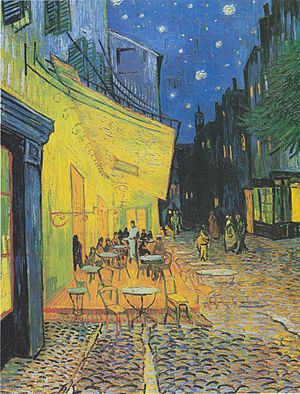
who enjoys the charm of his surrounding without any moral concern. It recalls Van Gogh's mood when he wrote that"the night is
more alive and more richly colored than the day."The color is more profuse and the eye wanders along the steeped or dove tailed
edges of neighboring areas-irregular shapes fitted to each other like a jigsaw puzzle design. To divide this space for long into
a large object and background themes is difficult for the eyes; the distant and nearer parts are alike distinct. The yellow Cafe
plays againts the blue-balck of the remote street and the violet-blue of the foreground door,and, by a paradox of composition that
helps to unify the work, at the stringest point of contrast the awning's blunt corner nearset to us touches the remote blue sky.
Foreshortened lines thrust into the depth, like the intel of the door, are strictly parallel to lines like the slope of the yellow
awning and the roof of the house above, which lie in palnes perpendicular to the first. For this roving, unengaged vision upward
dimension is no less importtant and expressive than the depth.
(1)In a Europan conference, it said that in the close study of the painting reveals that the main characters include one central figure with long
hair surrounded by 12 individuals, plus a cross shines in the background of the composition, and Van Gogh has included additional crosslike shapes
throughout the artwork. A shadowy figure slipping through the doorway may symbolize Judas. A religious illusion wouldn't be too out of chracter for
Van Gogh. Before devoting his attention to the painting, the famous Dutch artist wished to "preach the gospel everywhere," and his father, Theodore van
Gogh, was a pastor for a Dutch Reformed church.(2) Van Gogh never signed "Cafe Terrace at Night." However, he specifically mentioned the painting in three
pieces of correspondence, so art historians are confident that he painted it.(3) The painting has three separate titles. At it's first public exhibit in 1891
,the work bore the title "Cafe, le soir," or Coffeehouse at Evening. Another name goes by is "Cafe Terrace on the Place du Forum."(4) "Cafe Terrace at Night" is
one of three Arles paintings that feature Van Gogh's distinctive star filled sky. Starry Night and Starry Night over the Rhone complete the trilogy.(5) Vincent
painted the cafe terrace scene on location rather than from memory.(6) The cafe in the painting is still in existence, renamed the Cafe Van Gogh.(7) The
positions of the stars in the night sky of "Cafe Terrace at Night" is accurate, according to astrnomical data.